

Connecting Cancer Cells and NK Cells While Reprogramming Macrophages… INU Proposes a New Strategy for Multifunctional Exosome-Based Cancer Immunotherapy
- NO
- 433680
- Date
- 2026-11-09
- modification day
- 2026-11-09
- Writer
- 홍보과 (032-835-9490)
- Count
- 37

From left: Professor Lee Won-jong, Dr. Kang Su-jin, and students Baek Gi-chan, Joo Su-woon, Kim Geon-hee, and Kwak Seong-jin
- Exosomes Bridge Cancer Cells and NK Immune Cells While Reprogramming Tumor-Supporting Macrophages into Cancer-Fighting Cells to Maximize Antitumor Activity -
A research team at Incheon National University (INU), led by President Injae Lee, has proposed a new cancer immunotherapy strategy that uses exosomes to directly connect breast cancer cells with natural killer (NK) immune cells while reprogramming surrounding immune cells that previously supported tumor growth into cancer-fighting cells.
The researchers engineered exosomes derived from pro-inflammatory (M1-type) macrophages by attaching two different binding molecules to their surfaces, enabling a single exosome to perform two anticancer functions simultaneously: bridging cancer cells and NK cells, and reprogramming macrophages.
Cancer immunotherapies that harness immune cells to attack tumors have recently attracted considerable attention. However, many solid tumors, including breast cancer, are known to create an immunosuppressive environment around cancer cells, known as the tumor microenvironment, which reduces treatment effectiveness. In particular, immune cells that would normally protect the body can instead support tumor growth. This has created a need for technologies that recruit immune cells into tumor tissues and restore their anticancer functions.
The dual-targeting exosomes enhance antitumor immunity through two mechanisms.
First, two ligands on the exosome surface simultaneously bind to cancer cells and NK cells, acting as a molecular bridge that brings the two cell types into close physical proximity. This enables NK cells to recognize and attack cancer cells more effectively.
Second, the exosomes act on M2-type macrophages, which suppress immune responses and promote tumor growth, and induce their repolarization into M1-type macrophages with tumor-fighting properties. As a result, surrounding immune cells that previously remained inactive or supported cancer growth can participate in antitumor responses, reshaping the tumor microenvironment into one more favorable for immune-mediated cancer elimination.
Through experiments using breast cancer cells and animal models, the research team confirmed that the dual-targeting exosomes remodeled the tumor microenvironment more effectively and significantly enhanced NK cell-mediated antitumor immune responses compared with single-function exosomes.
The findings are particularly significant because the two mechanisms—bridging cancer cells and immune cells and reprogramming macrophages—work together to strengthen both direct tumor cell killing and the surrounding antitumor immune environment.
Professor Lee Won-jong of INU's Biotechnology Program, who led the research, emphasized, “The significance of this study lies in demonstrating that we can go beyond directly connecting cancer cells and immune cells to reprogram surrounding immune cells that previously supported tumor growth into cancer-fighting cells.”
He added, “By implementing two anticancer strategies simultaneously through a single exosome, we hope this approach will offer a new direction for developing treatments for difficult-to-treat solid tumors, including breast cancer.”
The research findings were published in the internationally renowned Journal of Extracellular Vesicles (Impact Factor: 21.7; top 5.6% in JCR rankings).
The study was supported by the Basic Research Laboratory (BRL) Program and the Mid-Career Researcher Program of the National Research Foundation of Korea (NRF), funded by the Ministry of Science and ICT.
Professor Lee Won-jong served as the corresponding author, while Dr. Kang Su-jin and student Baek Gi-chan of Incheon National University contributed as co-first authors. Students Joo Su-woon, Kim Geon-hee, and Kwak Seong-jin participated as co-authors.
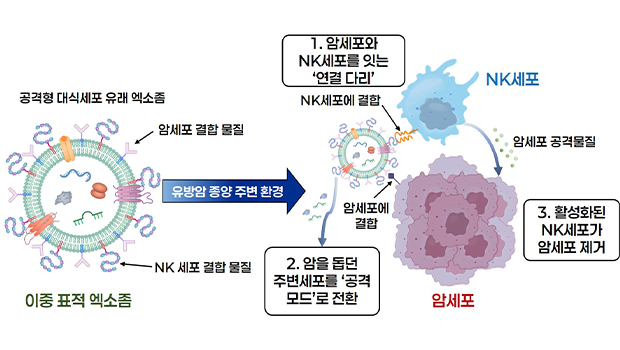
Mechanism of action of the dual-targeting exosomes developed by the INU research team. The researchers attached molecules that bind specifically to cancer cells and NK cells to the surfaces of exosomes derived from pro-inflammatory macrophages. These engineered exosomes bring cancer cells and NK cells into close proximity (①), reshape the surrounding tumor immune environment into a cancer-fighting state (②), and help NK cells eliminate cancer cells more effectively (③).
(Original Figure Source:https://doi.org/10.1002/jev2.70379)
- attached file
- There are no attachments.